Looting
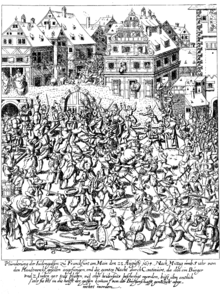
Looting refers to the act of stealing, or the taking of goods by force, in the midst of a military, political, or other social crisis, such as war,[1] natural disasters (where law and civil enforcement are temporarily ineffective),[2] or rioting.[3] The proceeds of all these activities can be described as booty, loot, plunder, spoils, or pillage.[4][5]
During modern-day armed conflicts, pillaging is prohibited by international law, and constitutes a war crime.[6]
Looting by type
Looting following disasters
During a disaster, police and military forces are sometimes unable to prevent looting when they are overwhelmed by humanitarian or combat concerns, or cannot be summoned due to damaged communications infrastructure. Especially during natural disasters, many civilians may find themselves forced to take what does not belong to them in order to survive.[7] How to respond to this, and where the line between unnecessary "looting" and necessary "scavenging" lies, is often a dilemma for governments.[8][9] In other cases, looting may be tolerated or even encouraged by governments for political or other reasons, including religious, social or economic ones.
In armed conflict

Looting by a victorious army during war has been common practice throughout recorded history. Foot soldiers viewed plunder as a way to supplement an often meagre income[10] and transferred wealth became part of the celebration of victory. In the upper ranks, the proud exhibition of the loot plundered formed an integral part of the typical Roman triumph, and Chinggis Khan was not unusual in proclaiming that the greatest happiness was "to vanquish your enemies ... to rob them of their wealth".[11]
In warfare in ancient times, the spoils of war included the defeated populations, which were often enslaved. Women and children might become absorbed into the victorious country's population, as concubines, eunuchs and slaves.[12][13] In other pre-modern societies, objects made of precious metals were the preferred target of war looting, largely due to their ease of portability. In many cases looting offered an opportunity to obtain treasures that otherwise would not have been obtainable. Since the 18th century, works of art have increasingly become a popular target. In the 1930s, and even more so during the Second World War, Nazi Germany engaged in large-scale and organized looting of art and property, particularly in Nazi-occupied Poland.[14][15]
Looting, combined with poor military discipline, has occasionally been an army's downfall[citation needed] - troops who have dispersed to ransack an area may become vulnerable to counter-attack. In other cases, for example the Wahhabi sack of Karbala in 1801 or 1802, loot has contributed to further victories for an army.[16] Not all looters in wartime are conquerors; the looting of Vistula Land by the retreating Imperial Russian Army in 1915[17] was among the factors sapping the loyalty of Poles to the Russian Emperor. Local civilians can also take advantage of a breakdown of order to loot public and private property, as in events which took place at the National Museum of Iraq in the course of the Iraq War in 2003.[18] Lev Nikolayevich Tolstoy's novel War and Peace describes widespread looting by Moscow's citizens before Napoleon's troops entered the city in 1812, along with looting by French troops elsewhere.
In 1990 and 1991, during the Gulf War, Saddam Hussein's soldiers caused significant damage to Kuwaiti and Saudi infrastructure. They also stole from private companies and homes.[19][20] In April 2003, looters broke into the National Museum of Iraq and thousands of artefacts remain missing.[21][22]
Syrian conservation sites and museums are looted during the Syrian civil war, with items being sold on the international black market.[23][24] Reports from 2012, suggested that these antiquities were being traded for weapons by the various combatants.[25][26]
Prohibited under international law
Both customary international law and international treaties prohibit pillage in armed conflict.[6] The Lieber Code, Brussels Declaration (1874), and Oxford Manual recognized the prohibition against pillage.[6] The Hague Conventions of 1899 and 1907 ( modified in 1954) obliges military forces not only to avoid the destruction of enemy property, but to provide protection to it.[27] Article 8 of the Statute of the International Criminal Court provides that in international warfare, the "pillaging a town or place, even when taken by assault" counts as a war crime.[6] In the aftermath of World War II, a number of war criminals were prosecuted[by whom?] for pillage. The International Criminal Tribunal for the former Yugoslavia (operative from 1993 to 2017) brought several prosecutions for pillage.[6]
The Fourth Geneva Convention of 1949 explicitly prohibits the looting of civilian property during wartime.[6][28]
Theoretically, to prevent such looting, unclaimed property is moved to the custody of the Custodian of Enemy Property, to be handled until returned to its owners.
Archaeological removals
The term "looting" is also sometimes used to refer to antiquities being removed from countries by unauthorized people, either domestic people breaking the law seeking monetary gain, or by foreign nations, which are usually more interested in prestige or previously, "scientific discovery". An example of this might be the removal of the contents of Egyptian tombs which were transported to museums across the West.[29] Whether this constitutes "looting" is a debated point, with other parties pointing out that the Europeans were usually given permission of some sort, and that many of the treasures wouldn't have been discovered at all if the Europeans hadn't funded and organized the expeditions or digs that located them. Many of these antiquities have already been returned to their country of origin voluntarily.
Looting of industry
In the aftermath of the Second World War, Soviet forces systematically plundered the Soviet occupation zone of Germany, including the Recovered Territories which were to be transferred to Poland. They sent valuable industrial equipment, infrastructure and whole factories to the Soviet Union.[30][31] The Allies, without rail transport and blocked by the seas, were limited to pillage of high value German scientific and industrial technologies such as rocketry and jet aircraft.
Many factories in the rebels' zone of Aleppo during the Syrian civil war were reported as being plundered and their assets transferred abroad.[32][33] Agricultural production and electronic power plants were also taken to be sold elsewhere.
| This article uses material from the Wikipedia article Metasyntactic variable, which is released under the Creative Commons Attribution-ShareAlike 3.0 Unported License. |