Apostille Convention
 State parties to the convention (members of the HCCH) State parties to the convention (non-members of the HCCH) State parties for which the convention has not entered into force | |
| Signed | 5 October 1961 |
| Location | The Netherlands |
| Effective | 14 January 1965 |
| Condition | ratification by 3 states |
| Parties | 118 |
| Depositary | Ministry of Foreign Affairs (Netherlands) |
| Languages | French (prevailing in case of divergence) and English |
 Apostille Convention at Wikisource Apostille Convention at Wikisource | |
The Hague Convention Abolishing the Requirement of Legalisation for Foreign Public Documents, the Apostille Convention, or the Apostille Treaty, is an international treaty drafted by the Hague Conference on Private International Law. It specifies the modalities through which a document issued in one of the signatory countries can be certified for legal purposes in all the other signatory states. A certification under the terms of the convention is called an apostille (from Latin post illa and then French: a marginal note) or Hague apostille.[2] It is an international certification comparable to a notarisation in domestic law, and normally supplements a local notarisation of the document. If the convention applies between two countries, such an apostille is sufficient to certify a document's validity, and removes the need for double-certification, by the originating country and then by the receiving country.
Procedure
Apostilles are affixed by Competent Authorities designated by the government of a state which is party to the convention.[3] A list of these authorities is maintained by the Hague Conference on Private International Law. Examples of designated authorities are embassies, ministries, courts or (local) governments. For example, in the United States, the Secretary of State of each state and his or her deputies are usually competent authorities. In the United Kingdom all apostilles are issued by the Foreign and Commonwealth Office in Milton Keynes.[4]
To be eligible for an apostille, a document must first be issued or certified by an officer recognised by the authority that will issue the apostille. For example, in the US state of Vermont, the Secretary of State maintains specimen signatures of all notaries public, so documents that have been notarised are eligible for apostilles.[5] Likewise, courts in the Netherlands are eligible to place an apostille on all municipal civil status documents directly. In some cases, intermediate certifications may be required in the country in which the document originates before it is eligible for an apostille. For example, in New York City, the Office of Vital Records (which issues, among other things, birth certificates) is not directly recognised by the New York Secretary of State.[6] As a consequence, the signature of the City Clerk must be certified by the County Clerk of New York County to make the birth certificate eligible for an apostille.[7][8] In Japan all official documents are issued in Japanese; the Ministry of Foreign Affairs (MOFA, JAPAN) can then provide an apostille for these documents.[9] In India the apostille certification can be obtained from the Ministry of External Affairs[10] in New Delhi, after authentication by the administration of the Indian state where the document was issued (for educational documents).
Information
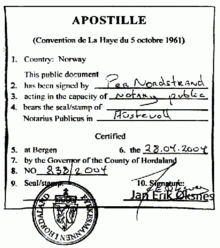
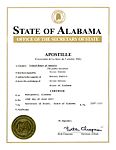
The apostille itself is a stamp or printed form consisting of ten numbered standard fields. At the top is the text Apostille, under which the text Convention de La Haye du 5 octobre 1961 (French for "Hague Convention of 5 October 1961") is placed. This title must be written in French for the apostille to be valid (article 4 of the Convention). In the numbered fields, the following information is added,which may be in the official language of the authority that issues it or in a second language:
- Country ... [e.g. Korea, Spain, Hong Kong]
This public document - has been signed by [e.g. Henry Cho]
- acting in the capacity of [e.g. Notary Public]
- bears the seal/stamp of [e.g. High Court of Hong Kong]
Certified - at [e.g. Hong Kong]
- the ... [e.g. 16 April 2014]
- by ... [e.g. the Chief Executive of the Special Administrative Region of Hong Kong]
- No ... [e.g. 2536218517]
- Seal/stamp ... [of the authority giving the apostille]
- Signature
The information can be placed on the document itself, on the back of the document, or attached to the document as an allonge.
Eligible documents
Four types of documents are mentioned in the convention:[1]
- court documents
- administrative documents (e.g. civil status documents)
- notarial acts
- official certificates which are placed on documents signed by persons in their private capacity, such as official certificates recording the registration of a document or the fact that it was in existence on a certain date and official and notarial authentications of signatures.
Legalization
A state that has not signed the Convention must specify how foreign legal documents can be certified for its use. Two countries may have a special convention on the recognition of each other's public documents, but in practice this is infrequent. Otherwise, the document must be certified by the foreign ministry of the country in which the document originated, and then by the foreign ministry of the government of the state in which the document will be used; one of the certifications will often be performed at an embassy or consulate. In practice this means the document must be certified twice before it can have legal effect in the receiving country. For example, as Canada is not a signatory, Canadian documents for use abroad must be certified by the Deputy Minister of Foreign Affairs in Ottawa or by a Canadian consular official abroad, and subsequently by the relevant government office or consulate of the receiving state.
- Apostille vs. Legalization

States that are party to the convention
The convention has 118 parties and is in force for all members of the European Union and all but nine members of the Hague Conference on Private International Law.
| State | Entry into force | Apostille not recognised in | Comment |
|---|---|---|---|
 Albania Albania | 9 May 2004 | Belgium (until 2015), Germany (until 2016), Greece (until 2018), Italy (until 2011), Spain (until 2017) | |
 Andorra Andorra | 31 Dec 1996 | ||
 Antigua and Barbuda Antigua and Barbuda | 1 Nov 1981 | ||
 Argentina Argentina | 18 Feb 1988 | Kosovo | |
 Armenia Armenia | 14 Oct 1994 | Kosovo | |
 Australia Australia | 16 Mar 1995 | ||
 Austria Austria | 13 Jan 1968 | Burundi, Dominican Republic, Kosovo, Kyrgyzstan, Mongolia, Philippines, Tajikistan, Tunisia, Uzbekistan | |
 Azerbaijan Azerbaijan | 2 Mar 2005 | Germany, Hungary (until 2005), Kosovo, Netherlands (until 2010) | |
 Bahamas Bahamas | 10 Jul 1973 | ||
 Bahrain Bahrain | 31 Dec 2013 | ||
 Barbados Barbados | 30 Nov 1966 | ||
 Belarus Belarus | 31 May 1992 | Kosovo | |
 Belgium Belgium | 9 Feb 1973 | Albania (until 2015), Dominican Republic, India (until 2008), Kyrgyzstan, Liberia, Mongolia, Tajikistan, Tunisia, Ukraine (until 2004), Uzbekistan | |
 Belize Belize | 11 Apr 1993 | ||
 Bolivia Bolivia | 7 May 2018 | ||
 Bosnia and Herzegovina Bosnia and Herzegovina | 6 Mar 1992 | ||
 Botswana Botswana | 30 Sep 1966 | ||
 Brazil Brazil | 14 Aug 2016 | ||
 Brunei Brunei | 3 Dec 1987 | ||
 Bulgaria Bulgaria | 29 Apr 2001 | ||
 Burundi Burundi | 13 Feb 2015 | Austria, Czech Republic, Germany, Poland | |
 Cape Verde Cape Verde | 13 Feb 2010 | ||
 Chile Chile | 30 Aug 2016 | ||
 Colombia Colombia | 30 Jan 2001 | ||
 Cook Islands Cook Islands | 30 Apr 2005 | ||
 Costa Rica Costa Rica | 14 Dec 2011 | ||
 Croatia Croatia | 8 Dec 1991 | ||
 Cyprus Cyprus | 30 Apr 1973 | Kosovo | |
 Czech Republic Czech Republic | 16 Mar 1999 | ||
 Kingdom of Denmark Kingdom of Denmark | 26 Dec 2006 | Does not apply for Greenland and the Faroe Islands | |
 Dominica Dominica | 3 Nov 1978 | ||
 Dominican Republic Dominican Republic | 30 Aug 2009 | Austria, Belgium, Germany, the Netherlands (until 2017) | |
 Ecuador Ecuador | 2 Apr 2005 | ||
 El Salvador El Salvador | 31 May 1996 | ||
 Estonia Estonia | 30 Sep 2001 | ||
 Fiji Fiji | 10 Oct 1970 | ||
 Finland Finland | 26 Aug 1986 | Philippines | |
 France France | 24 Jan 1965 | ||
 Georgia Georgia | 14 May 2007 | Germany (until 2010), Kosovo, Greece (until 2015) | |
 Germany Germany | 13 Feb 1966 | Albania (until 2016), Azerbaijan, Burundi, Dominican Republic, Georgia (until 2010), India, Kosovo, Kyrgyzstan, Liberia, Moldova, Mongolia, Morocco, Paraguay, Peru (until 2014), Philippines, Tajikistan, Tunisia, Ukraine (until 2010), Uzbekistan | |
 Greece Greece | 18 May 1985 | Albania (until 2018), Georgia (until 2015), Kosovo, Kyrgyzstan, Mongolia, Peru, Philippines, Tunisia, Uzbekistan | |
 Grenada Grenada | 7 Apr 2002 | ||
 Guatemala Guatemala | 18 Sep 2017 | ||
 Guyana Guyana | 18 April 2019 | ||
 Honduras Honduras | 30 Dec 2004 | ||
 Hong Kong Hong Kong | 25 Apr 1965 | The convention is still applicable to Hong Kong despite the transfer of sovereignty over Hong Kong on 1 Jul 1997.[11] | |
 Hungary Hungary | 18 Jan 1973 | Azerbaijan (until 2005), | |
 Iceland Iceland | 27 Nov 2004 | ||
 India India | 14 Jul 2005 | Belgium (until 2008), Finland (until 2009), Germany,[12] Netherlands (until 2008), Spain (until 2008), Kosovo | |
 Ireland Ireland | 9 Mar 1999 | ||
 Israel Israel | 14 Aug 1978 | Kosovo | |
 Italy Italy | 11 Feb 1978 | Albania (until 2011), | |
 Japan Japan | 27 Jul 1970 | ||
 Kazakhstan Kazakhstan | 30 Jan 2001 | ||
 Kosovo Kosovo | 14 Jul 2016 | Argentina, Armenia, Austria, Azerbaijan, Belarus, China (for Hong Kong and Macao), Cyprus, Germany, Georgia, Greece, India, Israel, Mauritius, Nicaragua, Mexico, Moldova, Namibia, Paraguay, Peru, Poland, Russia, Romania, Serbia, Slovakia, Spain, Ukraine, Uzbekistan, Venezuela | |
 Kyrgyzstan Kyrgyzstan | 31 Jul 2011 | Austria, Belgium, Germany, Greece | |
 Latvia Latvia | 30 Jan 1996 | ||
 Lesotho Lesotho | 4 Dec 1966 | ||
 Liberia Liberia | 8 Feb 1996 | Belgium, Germany, the United States (until 2015) | |
 Liechtenstein Liechtenstein | 17 Sep 1972 | ||
 Lithuania Lithuania | 19 Jul 1997 | ||
 Luxembourg Luxembourg | 3 Jun 1979 | ||
 Macau Macau | 4 Feb 1969 | Kosovo | The convention is still applicable to Macau despite the transfer of sovereignty over Macau on 20 Dec 1999.[11] |
 Malawi Malawi | 2 Dec 1967 | ||
 Malta Malta | 3 Mar 1968 | ||
 Marshall Islands Marshall Islands | 14 Aug 1992 | ||
 Mauritius Mauritius | 12 Mar 1968 | Kosovo | |
 Mexico Mexico | 14 Aug 1995 | Kosovo | |
 Moldova Moldova | 16 Mar 2007 | Germany, Kosovo | |
 Monaco Monaco | 31 Dec 2002 | ||
 Mongolia Mongolia | 31 Dec 2009 | Austria, Belgium, Finland, Germany, Greece | |
 Montenegro Montenegro | 3 Jun 2006 | ||
 Morocco Morocco | 14 Aug 2016 | Germany | |
 Namibia Namibia | 30 Jan 2001 | Kosovo | |
 Kingdom of the Netherlands Kingdom of the Netherlands | 8 Oct 1965 | Azerbaijan (until 2010), Dominican Republic (until 2017), India (until 2008), | Aruba, Curaçao, Netherlands, Sint Maarten |
 New Zealand New Zealand | 22 Nov 2001 | ||
 Nicaragua Nicaragua | 14 May 2013 | Kosovo | |
 Niue Niue | 2 Mar 1999 | ||
 North Macedonia North Macedonia | 17 Nov 1991 | ||
 Norway Norway | 29 Jul 1983 | ||
 Oman Oman | 30 Jan 2012 | ||
 Palau Palau | 23 Jun 2020 | ||
 Panama Panama | 4 Aug 1991 | ||
 Paraguay Paraguay | 30 Aug 2014[13] | Germany, Kosovo | |
 Peru Peru | 30 Sep 2010 | Germany (until 2014), Greece, Kosovo | |
 Philippines Philippines | 14 May 2019 | Austria, Finland, Germany, Greece | |
 Poland Poland | 14 Aug 2005 | Kosovo | |
 Portugal Portugal | 4 Feb 1969 | ||
 Romania Romania | 13 Mar 2001 | Kosovo | |
 Russia Russia | 31 May 1992 | ||
 Saint Kitts and Nevis Saint Kitts and Nevis | 14 Dec 1994 | ||
 Saint Lucia Saint Lucia | 31 Jul 2002 | ||
 Saint Vincent and the Grenadines Saint Vincent and the Grenadines | 27 Oct 1979 | ||
 Samoa Samoa | 13 Sep 1999 | ||
 San Marino San Marino | 13 Feb 1995 | ||
 São Tomé and Príncipe São Tomé and Príncipe | 13 Sep 2008 | ||
 Serbia Serbia | 27 Apr 1992 | Kosovo | Ratified as the  Federal Republic of Yugoslavia Federal Republic of Yugoslavia |
 Seychelles Seychelles | 31 Mar 1979 | ||
 Slovakia Slovakia | 18 Feb 2002 | Kosovo | |
 Slovenia Slovenia | 25 Jun 1991 | ||
 South Africa South Africa | 30 Apr 1995 | ||
 South Korea South Korea | 14 Jul 2007 | ||
 Spain Spain | 25 Sep 1978 | Albania, India (until 2008), Kosovo | |
 Suriname Suriname | 25 Nov 1975 | ||
 Swaziland Swaziland | 6 Sep 1968 | ||
 Sweden Sweden | 1 May 1999 | ||
 Switzerland Switzerland | 11 Mar 1973 | ||
 Tajikistan Tajikistan | 31 Oct 2015 | ||
 Tonga Tonga | 4 Jun 1970 | ||
 Trinidad and Tobago Trinidad and Tobago | 14 Jul 2000 | ||
 Tunisia Tunisia | 30 Mar 2018 | Austria, Belgium, Germany, Greece | |
 Turkey Turkey | 29 Sep 1985 | ||
 Ukraine Ukraine | 22 Dec 2003 | Belgium (until 2004), Greece (until 2010), Kosovo | |
 United Kingdom United Kingdom | 24 Jan 1965 | Includes Crown Dependencies and British Overseas Territories | |
 United States United States | 15 Oct 1981 | Liberia (until 2015) | |
 Uruguay Uruguay | 14 Oct 2012 | ||
 Uzbekistan Uzbekistan | 15 Apr 2012 | Austria, Belgium, Germany, Greece, Kosovo | |
 Vanuatu Vanuatu | 30 Jul 1980 | ||
 Venezuela Venezuela | 16 Mar 1999 | Kosovo |
Abuse
The apostille does not give information regarding the quality of the content in the underlying document but certifies the signature (and the capacity of who placed it) and correctness of the seal/stamp on the document which must be certified. In 2005 the Hague Conference surveyed its members and produced a report in December 2008 which expressed serious concerns about diplomas and degree certificates issued by diploma mills. The possible abuse of the system was highlighted: "Particularly troubling is the possible use of diploma mill qualifications to circumvent migration controls, possibly by potential terrorists." (page 5) The risk comes from the fact that the various government stamps give the document an air of authenticity without anyone having checked the underlying document. "An official looking certificate may be issued to a copy of a diploma mill qualification, and then subsequently issued with an apostille, without anyone having ever verified the signature on, let alone the contents of, the diploma." (page 7) Further member states indicated "they would be obliged to issue an apostille for certification of a certified copy of a diploma issued by a diploma mill". (page 15) The evaluation commission of the Hague Conference expressed concern as to whether this issue could affect the entire convention. "... the apostille does not 'look through the certification' and does not relate to the diploma itself ... There is a clear risk that such practices may eventually undermine the effectiveness and therefore the successful operation of the apostille Convention". (page 5)[14]
In February 2009 the Hague Conference recommended to amend the wording on the apostille to make it clear that only the seal and the signature were authenticated. The wording to be added is:
Validity
Technically, an apostille never expires once issued. However, there are some factors which may render an apostilled document unusable in certain situations. If you intend to use a document or certificate you have acquired an apostille on outside of the convention, you may be required to re-process the document. For example, if you are applying for a work permit in China, the apostille on your documentation must have been issued within the past six months in order to be valid for your application[15] .
Further stages of legalisation
Some Apostille Agreement member states will require additional stages after an apostille, dependent on use. If you are intending on marrying in Greece, for example, you will require a translation of your apostilled documents which must be verified at the Greek Consulate[16] before you can present them for your marriage licence in-country. It's advisable to check with whomever you are presenting the documents to what the requirements will be in each and every case.
| This article uses material from the Wikipedia article Metasyntactic variable, which is released under the Creative Commons Attribution-ShareAlike 3.0 Unported License. |